The Rocky 70's: Creating a Diverse UCF Faculty
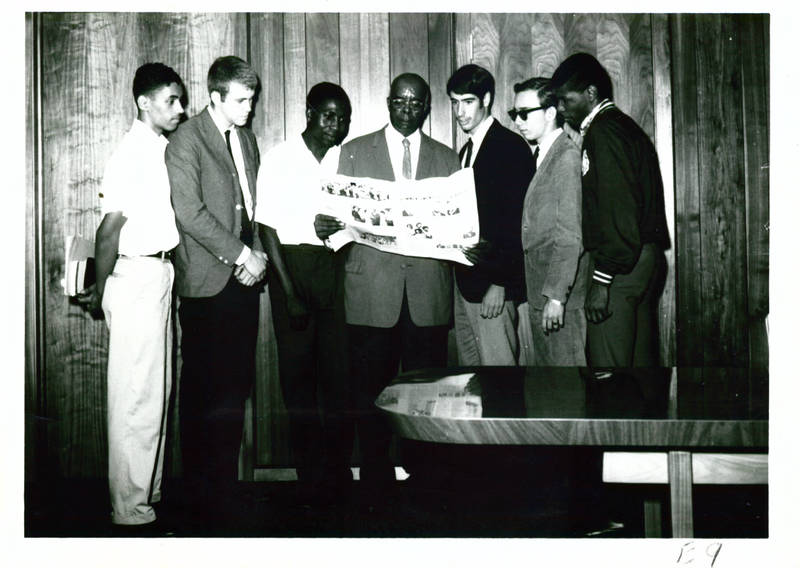

Like all Universities in the 1960’s, UCF scrambled to come to grips with the passage of the 1964 Civil Rights Act, which guaranteed the abolishment of racial discrimination in the public and private sphere. Concurrent with this legislation was a nation-wide effort to promote greater diversity in higher education, and a crucial component of that was to create faculties that reflected a more varied student population. The impulse for UCF to expand it’s hiring practices was motivated primarily by two forces: the Black Student Union (BSU) and the federal government. It was clear that change was spreading rapidly across the South during the 1970’s and Florida schools were not exempt.
The search for a diversified campus and student life at UCF seemed to enjoy a tremendous breakthrough in 1969, when the eye of the federal government came to rest upon the university, named FTU at the time. Before the Carter administration created the federal Department of Education, the Department of Health, Education and Welfare (HEW) was responsible for such matters. That year representatives from the government met with students from the BSU to discuss campus progress. Their meeting is a striking example of government and student-coordinated activism working hand-in-hand.[1] One of the primary demands of the students was a curriculum that provided some focus on African and African American history and, just as importantly, that these courses to be taught by an African American.[2] The discussions were not without controversy. The BSU staged a walkout of a meeting with Dean Millican because they believed that their demands were not seriously considered, much less being met.[3] However the Dean acceded to the demands, and the following quarter the first black history class was added to the curriculum. It was taught by Dr. Joseph Taylor, a visiting professor from Bethune-Cookman University.[4] But the most distinguished black professor at UCF came almost six years later. His name was Dr. John T. Washington and he was a sociologist, war veteran and active preacher from central Florida. As one of the first full-time African American professors at UCF, Dr. Washington added a wealth of skills and experience to the University.
The changeable nature of government policy was also a tremendous motivator for UCF to change. An initiative to make schooling in United States more inclusive had been brewing at the top levels of government for some time. The measures of Title VII had its direct antecedent in the Truman administration’s Report on Higher Education, which outlined a plan to make college more accessible to the underprivileged, more research-based and technical, and less discriminatory in its admissions.[5] This 1947 paper was the blueprint for higher education in the next sixty years, and UCF is an excellent example of a technically-based college that was born of this initiative. The HEW survey of UCF in 1969 earned the institution praise the following year, saying the school had followed the Civil Rights Act adequately.[6] But only three years later, HEW censured UCF along with other Florida public institutions for not taking enough steps to desegregate. It gave the Florida Board of Regents a mere ninety days to draft a detailed plan for diverse hiring and student admissions.[7] This motivated the school's administrators to act. In 1973 the Office of Equal Employment and Opportunities was founded, branching out from the previous Equal Opportunity Council created in 1970. It devised a complex method of formulas to calculate minority representation without resorting to outright quotas. Yet problems persisted. The most common reason given was that there was simply too small a pool of qualified applicants.[8] Another reason related to the first, was that money in the Florida budget was too tight as a result of the nationwide recession, which decreased incentives for any possible applicant. The late 1970’s seemed to be a rocky but formative period for UCF in it’s social development. The Office of Minority Student Affairs saw a change in leadership following widespread faculty dissatisfaction, and the BSU was once again calling for an increase in black representation among professors, rallying around the Reverend Abernathy in his fiery 1979 address in central Florida.[9] Thus, though major strides were taken in this decade, it was clear that progress was a difficult climb, rather than a smooth transition.
1. Jeff Pippin, "BSU to Meet HEW," Central Florida Future (Orlando), December 1, 1969, Vol. 02 ed., No. 09 sec. Accessed February 28, 2017, http://digitalcollections.net.ucf.edu/cdm/compoundobject/collection/ARC/id/15482/rec/4.
2. "Black History Added to Schedule," Central FLorida Future, April 2, 1970, Vol. 02 ed., No. 20 sec. Accessed February 28, 2017, http://digitalcollections.net.ucf.edu/cdm/compoundobject/collection/ARC/id/15601/rec/3.
3. "Black Studies Accepted Despite Walkout," Central Florida Future (Orlando), December 5, 1969, Vol. 02 ed., No. 10 sec. Accessed February 28, 2017, http://digitalcollections.net.ucf.edu/cdm/compoundobject/collection/ARC/id/15499/rec/1.
4. Ibid.3.
5. United States, President's Commission on Higher Education, Higher Education for American Democracy, A Report of the President's Commission on Higher Education, By George Frederick Zook, Washington: United States Gov't Print. Office, 1947, 1-27, https://catalog.hathitrust.org/Record/001117586.
6. "Minorities Represented at FTU," Central Florida Future (Orlando), April 10, 1970, Vol. 02 ed., No. 21 sec. Accessed February 28, 2017, http://digitalcollections.net.ucf.edu/cdm/compoundobject/collection/ARC/id/15614/rec/2.
7. "FTU Officials Reach Minorities," Central Florida Future (O), November 30, 1973, Vol. 06 ed., No. 09 sec. Accessed February 27, 2017, http://digitalcollections.net.ucf.edu/cdm/compoundobject/collection/ARC/id/26125/rec/1.
8. Holly Criswell, "Black Profs: at FTU, recruiting them is difficult," Central Florida Future (Orlando), February 20, 1976, Vol. 08 ed., No. 17, Accessed February 27, 2017, http://digitalcollections.net.ucf.edu/cdm/compoundobject/collection/ARC/id/27540/rec/1.
9. Joe Kilsheimer, "Abernathy: Carter forgot blacks," Central Florida Future (Orlando), February 9, 1976, Vol. 11 ed., No. 20, Accessed February 28, 2017, http://digitalcollections.net.ucf.edu/cdm/compoundobject/collection/ARC/id/33511/rec/1.