Advertising Orlando's Adaptation
As incoming businesses transformed Orlando's landscape during the economic boom of the 1950s and 1960s, the perception of the city changed to adapt to its development. In his book Land of Sunshine, State of Dreams, historian Gary Mormino offers insight into Orlando prior to this development and how it was perceived by visitors: "In 1950, every vacationer who visited Orlando’s downtown tourist office got his or her name in the paper. Visitors found Orlando a charming place, more small town than big city."
However, the introduction of the Martin Company and other technology industries to Central Florida at the beginning of the Space Race resulted in a different perception of the Orlando that was being projected to attract potential visitors and future residents. It is evident the City of Orlando both embraced the imminent development and capitalized on the inevitable national attention through the implementation of marketing strategies that posited the city as an ideal place to pursue the optimistic goals which defined the new Atomic Age—change and progress.
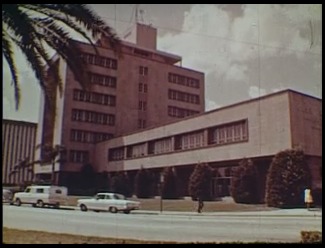
Campaigns of the era emphasized the changing landscape of Orlando as developed by new technological and industrial enterprises and defined by Atomic Age goals, while reminding audiences of the typical attractive perception of Florida as a land of sunshine and serenity. In a video produced by the Orlando Chamber of Commerce, the city was nicknamed "Action Center USA" and was described as "a modern vital, 20th-century city in the heart of an area that is alive with excitement and growth." Orlando's development made it the ideal city for the era's "new breed of man with his eyes to the stars and his feet firmly on the ground," who is "working hard to turn the dreams of tomorrow's world into a reality." The advertisement's proclamation that "all roads that lead to the state of Florida lead to Orlando" centers the city as the hub of Florida's gradual development and growth during the statewide military defense expansion of the 1960s. Anchoring and further advertising this development and growth was Orlando's new City Hall, featured in the video as the narrator proclaims "Orlando is a modern, bustling metropolis."
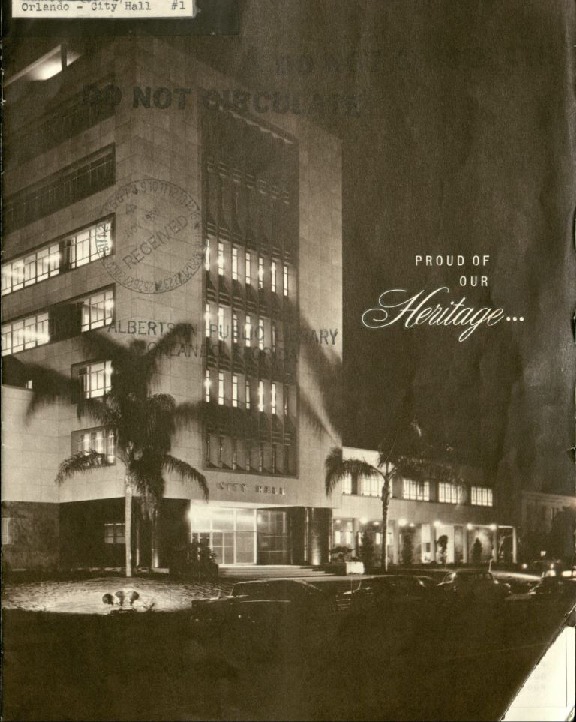
The brochure to the right advertises a new Orlando, a city dedicated to using the gift of development bestowed by the incoming technology industries to launch into the modern age. This promotional brochure explains how the recently constructed City Hall emulates the new modern era by standing as a symbol of progress—a sign that Orlando is a city which "adapts easily with change and plans ahead." This serves as an example of the local government's role in both championing and facilitating development. Housed within the new, adaptive City Hall and a developing Orlando, the various operations of city government and industrial enterprises are able to improve. This increased efficiency further underscores Orlando's government and landscape as adaptive to change, rendering the city even more attractive to new businesses and new families in pursuit of progress. Entrusted to a new generation of "young, vibrant 'pioneers' in an atomic era," Orlando and its heritage would be led into the modern era with "a new City Hall stand[ing] to guide the progress of all who would build a greater Orlando."
Bibliography
City of Orlando. "Proud of Our Heritage." Brochure. ca. 1958. Florida Collection. Orlando Public Library, Orlando. https://richesmi.cah.ucf.edu/omeka/items/show/7864.
Mormino, Gary R. Land of Sunshine, State of Dreams: A Social History of Modern Florida. Gainesville, FL: University Press of Florida, 2005.
Orlando Chamber of Commerce. "Action Center USA." Advertisement. Orlando: Tel Air Interests, Inc. From Florida Memory, Filming Florida: Images of the Sunshine State. MP4 video. Accessed March 15, 2016. https://www.floridamemory.com/items/show/232384.