The Martin Company Expands to Orlando
At the conclusion of World War II, America found herself in a new conflict, the Cold War. A vital component of this politically-charged contest between the United States and the Soviet Union was the Space Race. The final frontier had become a symbol of conquest and superiority—a trophy fit for the nation that would lead the free world.
Florida was ground zero for America's space-faring efforts with all of her craft being launched out of Cape Canaveral. Florida was selected for this task because it was the closest continental state to the Equator; NASA and military scientists wished to use this natural spin to aid in the launch of craft into space. Enter the Martin Company and the City of Orlando—a pairing that would help transform a small frontier town into Florida's largest inland city.
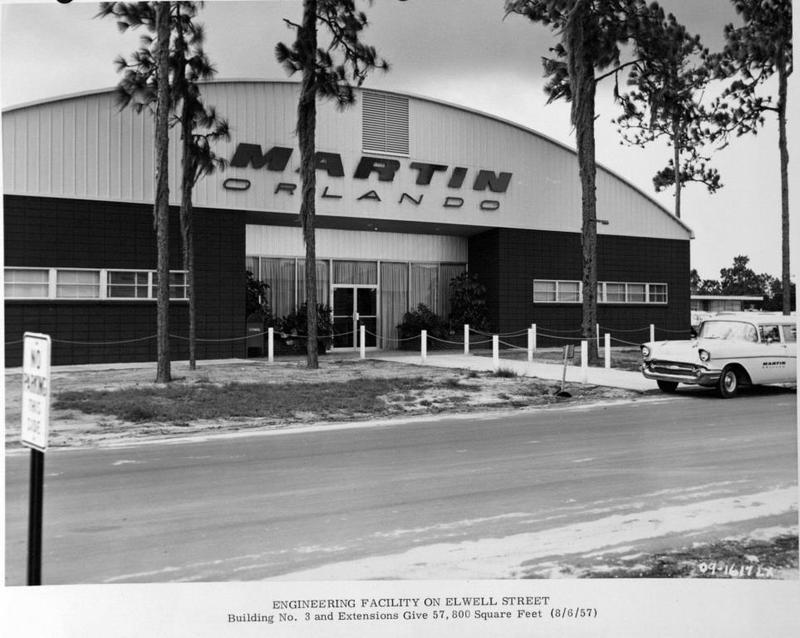
The Martin Company was a missile manufacturer originally based in Baltimore, Maryland. In 1956, the company expanded and bought 7,000 acres of land in South Orlando for $1.93 million. The purpose of the move, according to U.S. Department of Defense (DOD) appropriations hearings from 1962, was to "expand production in airframe, electronics and missiles areas." These same appropriations documents state that the government spent $4.123 million dollars to help facilitate the expansion to Florida.
Their motivation to incur such significant cost was to ensure lower overhead and cost with the Martin Company being closer to Cape Canaveral. Simply put: it was cheaper for the government to transport missiles from Orlando than from Baltimore. Also, as stated in Historic Orange County: The Story of Orlando and Orange County, "[g]ood highways, two military bases, a potential civilian work force, and abundant water supplies" were all area amenities that appealed to the Martin Company.
Orlando officials interested in boosting the city's agriculture-based economy sealed the deal, and the move to Orlando was guaranteed after several wining-and-dining sessions that resulted in the Martin Company buying much more land than originally intended at a discounted rate with incentives worth millions of dollars.
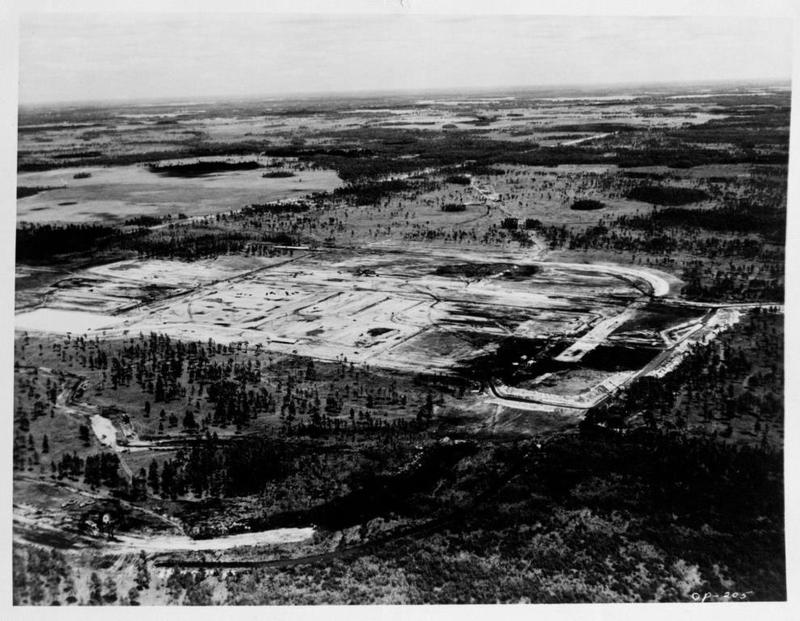
The effect that the Martin Company had on Orlando and the surrounding area was significant. The company helped transform a small agricultural town into a city at the forefront of technological development and advancement. According to author Joy Wallace Dickenson, "Within hours of the 1956 announcement that the missile building Martin Company had purchased land south of Orlando, nearby land prices jumped from $200 an acre to $1000 an acre."
The announcement was enough to entice Orlando residents into funding a new city hall exclusively through bonds supported by tobacco sales tax. Employing around 10,000 people at its peak, the business served as a magnet to other companies within tech industry bringing them to Orlando. Trees gave way to rows of houses and industrial parks as people flocked to the area. The Martin Company introduced a new class of skilled worker and salary that was unheard of prior to its arrival—the base wage was double that of the area average.
As of 1990, the Martin Company has given $6.3 billion to the development of the Central Florida area. While operating under a new name, LockheedMartin, the company is still based in Orlando to this day and is a worldwide leader in aerospace, security, and defense technologies.
Bibliography
Leusner, Jim, and Christopher Quinn. "Martin Transformed A Citrus Town." The Orlando Sentinel, March 18, 1990. Accessed February 22, 2016. http://articles.orlandosentinel.com/1990-03-18/news/9003173659_1_martin-orlando-missiles.
Wood, Bill. "MARTIN MARIETTA MARKS 30 YEARS IN ORLANDO, FLA." The Washington Post, December 7, 1987. Accessed March 7, 2016. https://washingtonpost.com/archive/business/1987/12/07/martin-marietta.
Dickinson, Joy Wallace. Historic Photos of Orlando. Nashville, Tenn: Turner Pub. Co, 2007.
Homan, Lynn M., and Thomas Reilly. Orlando in Vintage Postcards. Charleston, SC: Arcadia Publishing, 2001.
Porter, Tana Mosier, Cassandra Fyotek, Stephanie Gaub. Antequino, Cynthia Cardona Meléndez, Garret Kremer-Wright, and Barbara Knowles. Historic Orange County: The Story of Orlando and Orange County. San Antonio, TX:Historical Pub. Newtork, 2009.
Rajtar, Steve. A Guide to Historic Orlando. Charleston, SC: History Press, 2006.
U.S. Congress. Senate. Committee on Department of Defense. Department of Defense appropriations. 87th Cong., 1st sess., 1962. S. Rep., pt. 5-6.
Archer, Kevin. "The Limits to the Imagineered City: Sociospatial Polarization in Orlando." Economic Geography, Vol. 73, No. 3 (Jul, 1997): 322-336.