Father of the Modern Orlando Police Department
Robert Joseph Chewning was born October 22, 1923, in Baltimore, Marylond. His father was an iron worker who worked to build bridges. Chewning proudly served in the 8th Army Air Force during World War II. By the conclusion of the war, By 1946, Chewning had moved to the Central Florida area and became apolice beat officer for the Orlando Police Department (OPD). He would patrol the streets of the City Beautiful at a time when a mere 50,000 called it home. During that time, the most notorious crime was a home burglary and safe crackers were as serious a public enemy as they came. The OPD headquarters was nothing more than a rickety wooden building and the force itself almost entirely white. Then came the 1960s, and amidst the tumult and trials of that infamous decade came a very important event for Orlando. Bob Chewning was made Chief of Police after nearly two decades of stellar service to the city.
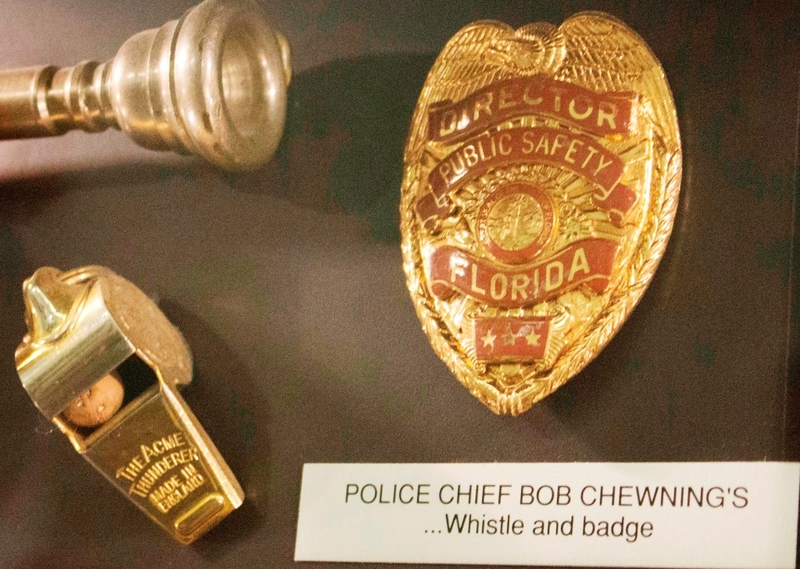
Chief Chewning's shield and whistle are symbols not only of law and order but also of leadership by example. He transformed the OPD in so many ways that he is often referred to as the "Father of the Modern-Day Orlando Police Department."
One of Mayor Carl T. Langford;ss first actions as the new mayor in 1967 was to appoint Bob Chewning Chief of Police, despite the fact that Chewning had not supported Mayor Langford in his bid for the seat following the death of Mayor Bob Carr. Like his father before him, Chief Chewning would be a bridge builder; the bridges he built ones of community and public trust. Chief Chewning modernized the police force in a very visible way to the community OPD served. He moved OPD from the rickety wooden building to Hughey Avenue near downtown's core in 1972, where it would remain in the Municipal Police-Court Complex for the following 43 years. The complex housed the police headquarters, two city courtrooms, and a jail designed to hold 300 inmates. At the time, the city had 253 officers and the city had 97,000 residents.
One of the most important things to Chief Chewning was professionalism and his officers. He brought in the International Association of Chiefs of Police to bring professionalism to the department. This led to several new policies and actions chief among them the purchase of portable police radios, which revolutionized the way that officers could interact with one another and with their superiors to better serve the community and protect one another. Chief Chewning was able to secure the implementation of air conditioning for the K-9 patrol in 1971 and air-conditioned police vehicles in 1972.
To Chief Chewning, education was a very important part of improvement. He instituted the college education program for officers in the early 1970s. As with every other aspect of his character, Chief Chewning led by example. To highlight the importance of education, he spent his spare time earning his associate's degree from Valencia Community College in 1972 by taking night classes. He graduated with honors with his Associate of Arts degree, all while juggling his full-time job as Chief of Police.
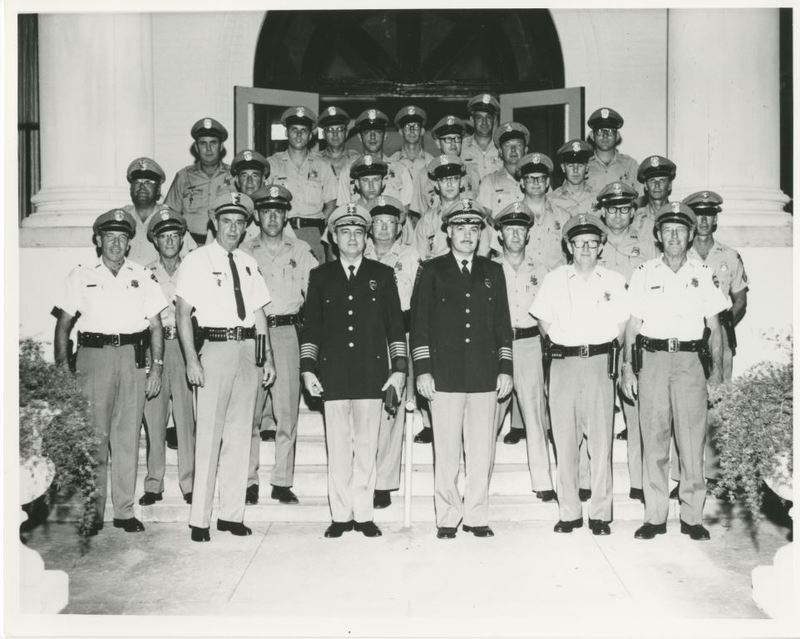
Chief Chewning served in a fully integrated unit during World War II and believed in the cause of civil rights. Previous chiefs had failed to move at all on the issue, but Chief Chewning once more led by example. Chief Chewning promoted the first black police Lieutenant, Richard Jones, over the objections of many in the city at the time. He did not stop there, however, and took things a step further and allowed black officers to patrol outside black neighborhoods. The city, which had been changing already demographically, was now being better represented by its police department.
Chief Chewning retired in the OPD in 1973 to take up the position as the city's public safety director. Later, he became Orange County public safety director and helped bring the 911 emergency system to the area, which would only compound the positive changes and influence he had concerning law enforcement and their relationship with and ability to protect the city.
Bibliography
Mariano, Willoughby. "Bob Chewning made integration a reality as Orlando police chief." The Orlando Sentinel, November 9, 2006. Accessed February 10, 2016. http://articles.orlandosentinel.com/2006-11-09/news/DEAD09_1_chewning-orlando-police-chief-grace.
Mathers, Sandra. "Richard Jones, Orlando's 1st Black Cop, Dies." The Orlando Sentinel, September 11, 1998. Accessed March 3, 2016. http://articles.orlandosentinel.com/1998-09-11/news/9809110028_1_arthur-jones-officer-jones-belvin-perry.
Periwinkle. "Bob Chewning's legacy." The Orlando Sentinel, November 11, 2006. Accessed February 11, 2016. http://articles.orlandosentinel.com/2006-11-11/news/ED113_1_chewning-police-department-police-chief.
Schlueb, Mark. "Demolition starts on site of new OPD headquarters." The Orlando Sentinel, December 11, 2014. Accessed March 4, 2016. http://www.orlandosentinel.com/news/breaking-news/os-new-orlando-police-station-20141212-story.html.
Weiner, Jeff. "Chief: New Orlando police station will bring cops, community together." The Orlando Sentinel, June 25, 2015. Accessed March 4, 2016. http://www.orlandosentinel.com/news/breaking-news/os-new-orlando-police-station-groundbreaking-20150625-story.html.