From a Cattle Town to the City Beautiful: How Orlando Mayors Made the City Hospitable
Off the Ground
Ever since its incorporation in 1875, the City of Orlando has elected mayors to represent its citizens and shape the city. These mayors were solely responsible for numerous changes and developments, including the construction of multiple city halls, attracting businesses, and even appointing officials such as the Chief of Police. Throughout that time, these mayors have left their impression on the burgeoning city ever since, and in some cases those effects cans still be felt today.
Incorporated in 1875 with only 85 residents, the City of Orlando elected William Jackson Brack as their first mayor, who won in a landslide 21-1 vote against William A. Patrick. Brack, a captain in the Confederate Army during the Civil War, settled in Orlando sometime before 1873. Mayor Brack was elected to serve a year, and was re-elected to serve another one-year term, before leaving office and serving in the Florida House of Representatives. By the end of the election of 1875, Orlando had 10 elected officials, one of them being City Clerk James P. Hugey, and seven Aldermen while only having 29 registered voters.
From then on until 1881, Orlando had four mayors. Mayor J. H. Allen served from 1877 to 1878, followed by Mayor Charles H. Munger from 1878 to 1879, Mayor Alex M. Hyer from 1879 to 1880, and Mayor Robert L. Summerlin from 1880 to 1881. On July of that year, Mayor C. D. Sweet was elected to office, the same year that Orlando had been connected to Jacksonville via railroad, it represented the future growth of the town as by 1882 it would have over 6,000 inhabitants.
Establishing the City Beaufitul and Public Safety
1883 was a critical year in the history and development of Orlando. The father of Mayor Robert L. Summerlin, Jacob Summerlin, donated land around Lake Eola for the use and creation of a public park, Lake Eola Park, which is still in use today.
During that same year, Orlando and its citizens began to get serious about fire protection and safety with the creation of a volunteer fire department, with William Sherman as Fire Chief. On January 12, 1884, Orlando suffered through the largest fire in the history of downtown, as it engulfed most of Business District, including Delaney's grocery store. This prompted Mayor John Letcher Bryan to create a permanent fire department in 1885, appointing John Weeks as the first Fire Chief, purchasing a fire truck, and organizing three fire companies to combat fires.
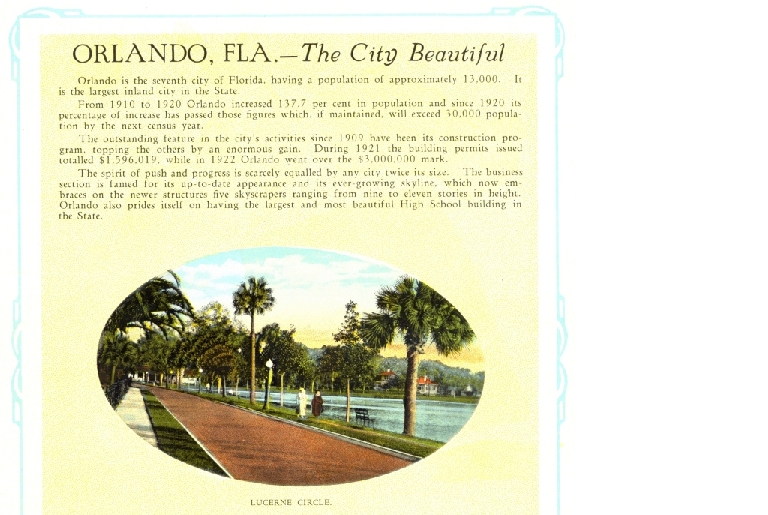
The 1890s saw both progression and destruction, as throughout the decade Orlando officials such as Mayor Willis Lucullus Palmer, Mayor Mahlon Gore, and Mayor James B. Parramore, undertook beautification programs that mostly consisted of planting new trees and awarding contracts to companies to plant such as in 1889, when the A. G. Branham & Company was given a contract to plant 400 trees. The city however would soon lose focus briefly on those projects due to the Great Freeze o 1894-1895, which crippled the citrus industry.
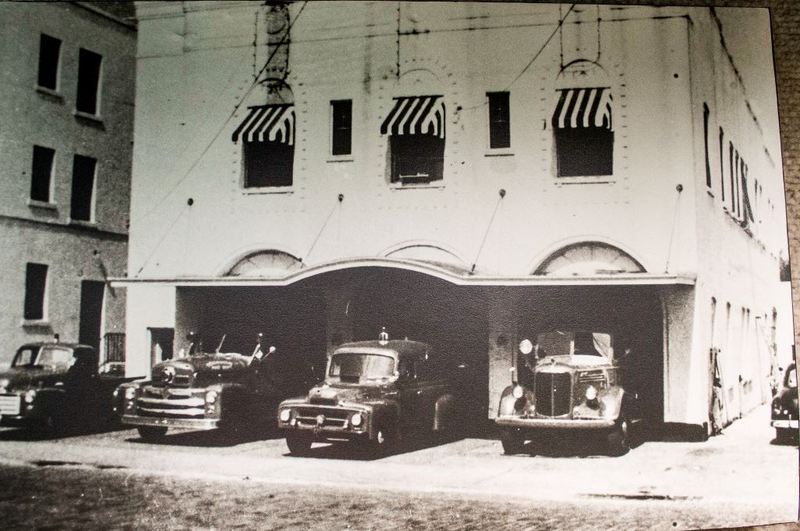
At the turn of the century, Orlando was been able to stabilize from the aftermath of the citrus freezes of the last decade, and looked forward to improving its infrastructure. In 1901, Mayor Parramore implemented the first speeding laws in the city, imposing a 5 mph speed limit in Downtown Orlando. Other mayors such as Mayor B. M. Robinson, Mayor J. H. Smith, and Mayor William H. Jewell, continued making improvements by focusing on paving roads and installing power lines throughout downtown. City Services also became more modernized as in 1907, the Orlando Fire Department had enough horses to adequately pull the fire wagons. In 1912, the City of Orlando passed an ordinance that required all wooden buildings to be demolished within a year. In 1914, the city would place some of its first street lights in the buisness district. In 1919, the fire station was moved to 19 North Main Street to better accommodate the needs of businesses and citizens.
Modernization
In 1927, the City of Orlando, led by Mayor Latta M. Autrey, purchased land from Dr. Phillip Phillips amidst a land bust which saw Orlando officials and workers take a 10-percent wage cut. With the land, the City developed it into the Orlando Municipal Airport, and began service the following year in 1928.
By the 1930s, Orlando had fully embraced its status as a growing city and its public safety improvements reflected that. In 1934, Mayor Samule Yulee Way purchased four patrol cars and a motorcycle, which led to the creation of Orlando's first motor patrol. In 1935, the Civil Service Board for Firemen and Police Officers was created, followed the Ladies State Auxiliary in 1936.
Orlando continued to grow steadily through the early 1950s. During this period, Mayor William Beardall oversaw a portion of Orlando's postwar growth, the creation of McCoy Air Field, and instituted the first radio communications system.
While there had been certainly many different phases of trouble and doubt, Orlando found itself as one America’s most attractive, efficient, and technologically cities at the conclusion of World War II—thanks in large part to the steadfast diligence of Orlando's mayors, who worked tirelessly to not only beautify the city, but to improve, maintain, and create infrastructure and public services.
Bibliography
Clark, James C. Orlando, Florida: A Brief History. Charleston, South Carolina: The History Press, 2013.
Gore, E. H. Florida Sand to "The City Beautiful": A Historical Record of Orlando. Orlando, FL: Academy Press, 1952.
Dickinson, Joy Wallace. Orlando: City of Dreams. Charleston, SC: Arcadia Pub., 2003.
"The Political Graveyard: Mayors of Orlando, Florida." The Political Graveyard: Mayors of Orlando, Florida. Accessed March 10, 2016. http://politicalgraveyard.com/geo/FL/ofc/orlando.html.
"History." City of Orlando Fire Department. Accessed March 10, 2016. http://www.cityoforlando.net/fire/history/.
"History." In Orlando. Accessed March 12, 2016. http://www.frommers.com/destinations/orlando/681710.
Orange County Sheriff's Office Office of the Sheriff Historical Highlights." Orange County Sheriff's Office Office of the Sheriff Historical Highlights. Accessed March 12, 2016.http://www.ocso.com/officeofthesheriff/historicalhighlights/tabid/58/default.
"Orlando City Chief Resigns." The St. Petersburg Times, March 6, 1924. Accessed March 12, 2016. https://news.google.com/newspapers?nid=888&dat=19240306&id=2DQxAAAAIBAJ&sjid=ukwDAAAAIBAJ&pg=6887,7234647&hl=en.
"City of Orlando Fire Station No. 1." RICHES of Central Florida, accessed April 6, 2016, https://richesmi.cah.ucf.edu/omeka2/items/show/4101.
"Orlando, Fla. The City Beautiful." RICHES of Central Florida, accessed April 6, 2016, https://richesmi.cah.ucf.edu/omeka2/items/show/1362.