Private James Whitley
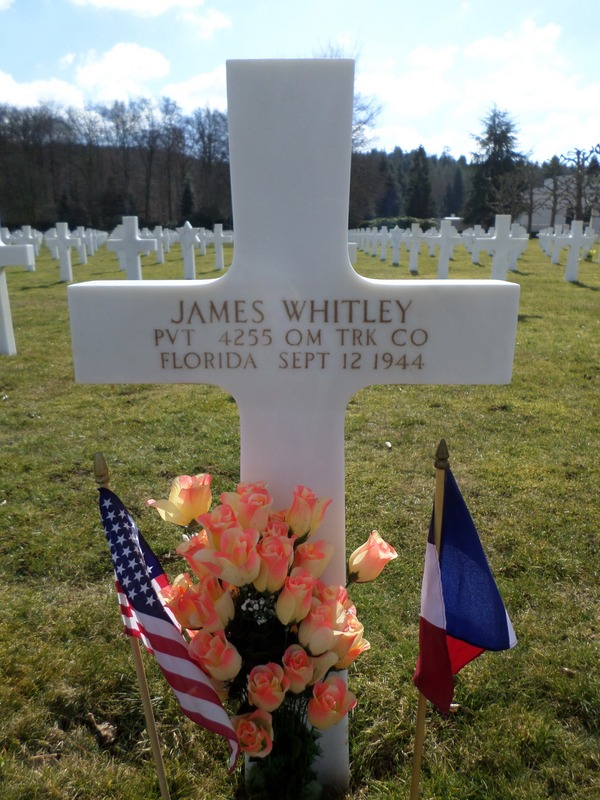
Private James Whitley, 4255th Quartermaster Truck Company
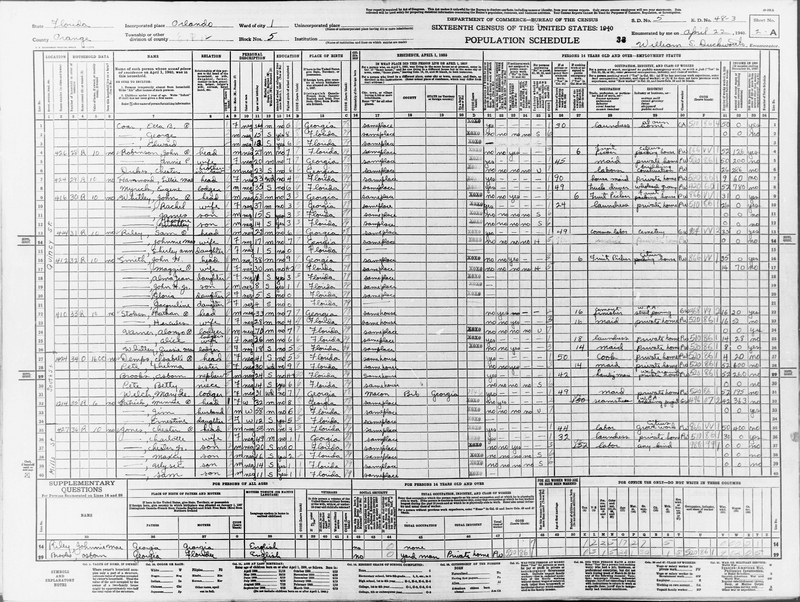
Private James Whitley was born in Orange County, Florida, in either late 1924 or early 1925.[1] His parents, John Whitely and Rachel Whitley, were born in Georgia in 1887 and 1904, respectively. The couple moved to Florida sometime before 1924, where they raised James and his brother, Theodore Whitley.[2] Their last recorded address was a segregated apartment complex at 1214H East South Street in either Winter Park or Orlando.[3] It is not clear whether the family lived in Winter Park or Orlando as both cities at the time had poor, African-American communities that provided much of the cheap labor for the surrounding area.[4] Pvt. Whitley's father worked as a laborer and Rachel Whitley worked as a laundress.[5]
Pvt. Whitley went to grade school until the third grade, where he either had no opportunities to finish his education as a result of segregation, or he had to leave school to help his father with work. The 1940 U.S. census states that John and James had been unemployed for some time, indicating that they struggled to find regular employment. The ability of the Whitleys, and of many other African-American families of the time, to find decent work in the job market was hindered by both institutionalized and informal racism that prevented non-whites from obtaining any economic independence that would better their position in society. James Whitley likely had to help the family earn enough money to survive given the deprivation they faced. Neither James nor his brother, Theodore, had known spouses or children, bringing an end to their familial lines.[6]
Drafted into the U.S. Army on February 9, 1943, Pvt. Whitley's service number was 34543070.[7][8] As a private in the 4255th Quartermaster Truck Company, a segregated African-American unit, he was charged with the responsibility of creating and maintaining supply lines to frontline units.[9][10] African-American units existed separately from white units and were exclusively support-oriented. This was a result of the prejudices held by military leaders at the time. They were hesitant to trust African Americans with frontline roles that required them to bare arms and competently follow orders. Upon his enlistment, Pvt. Whitley went to Camp Blanding, near Starke, for training before deployment to the Western Front.[11] Pvt. Whitley's company was stationed in Tytherley Village in Hampshire, England, on June 30, 1944, managing the flow of supplies to and from France following the D-Day invasion of Normandy on June 6, 1944.[12] Pvt. Whitley eventually traveled to France where he was killed in action on September 12, 1944.[13] He was awarded an American Campaign Medal, a World War II Victory Medal, and a Purple Heart for his service, which was extraordinary for an African-American soldier to receive at the time.[14] The fact that Pvt. Whitley was acknowledged for his sacrifice through a Purple Heart indicates that he might have died in direct combat with the enemy as opposed to through a bombing or artillery fire.
Wrtitten by Evan Murray and Kalynn Smith