Staff Sergeant Thomas E. Eason
Staff Sergeant Thomas E. Eason, 569th Bomber Squadron, 390th Bomber Group, Heavy




Even today, the horrors of World War II prove difficult to truly understand. The battles were often bloody and widespread; nevertheless, some of us studying the history of the war may forget that real men were behind the rifles and flight controls, and many of these real men never came home. One such man was Thomas E. Eason, who died in eastern France, near the German border.[1] Men like Eason, who lie in graves all over the world, were the men who fought the battles of World War II. In this sense, though his story is his own, Thomas Eason’s life draws many parallels with the lives of other men of his generation—most notably because of his humble upbringing but proud willingness to fight for his country and his death at only twenty-two years old. Eason died to enemy forces on January 20, 1945.[2]
Thomas Eason was born in North Carolina in 1922, the second oldest of three brothers and one sister. By the time of the 1930 U.S. Census, the survey listed Bessie, Eason’s mother, as the head of the household, while a Mr. Eason was absent.[3] By 1940, the family lived in Dade County, Florida. Thomas worked in textile fabrication—most likely in a textile mill. He completed four years of high school, but his textile occupation and later enlistment suggests that he did not attend college. His enlistment records note textile fabrication as his occupation when he joined the army as a private on August 20, 1941.[4]
Having enlisted in 1941, Eason was a soldier through the entire war. As reported by his crewmates, he saw action in both the Pacific and in Europe over the course of 28 missions.[5] Eason was a gunner in the Air Force. He flew with the 390th Bomber Group, 569th Bomber Squadron on a B-17 nicknamed “Sweet and Lovely.” The Air Force activated the 390th on January 26, 1943, in Spokane, Washington, and later moved operations to Framlingham, England, in July of the same year. It was part of the Eighth Air Force, which encompasses America’s heavy bombing force, and thus carried out strategic bombings across the European Theater of World War II.[6] The 390th twice acquired the Presidential Unit Citation, awarded for “extraordinary heroism in action against an armed enemy occurring on or after 7 December 1941.”[7] It is no surprise they did, either—the 390th bomber group contributed to some of the most infamous campaigns of the war. On June 6, 1944, they “bombed the coast near Caen fifteen minutes before the landings in Normandy,” and from December, 1944 through January, 1945, they helped “cut German supply lines during the Battle of the Bulge.”[8] Eason’s enlistment early in the war, compounded with his documented service in the 390th bomber group and location in France at the time of his death, all suggest that he himself might have been present during these important campaigns. The fact that he was three times awarded the Distinguished Flying Cross, given “for heroism or achievement for individuals involved in aviation,” further solidifies the idea that Eason may have fought above some of the most notorious battles through 1944 and 1945.[9]
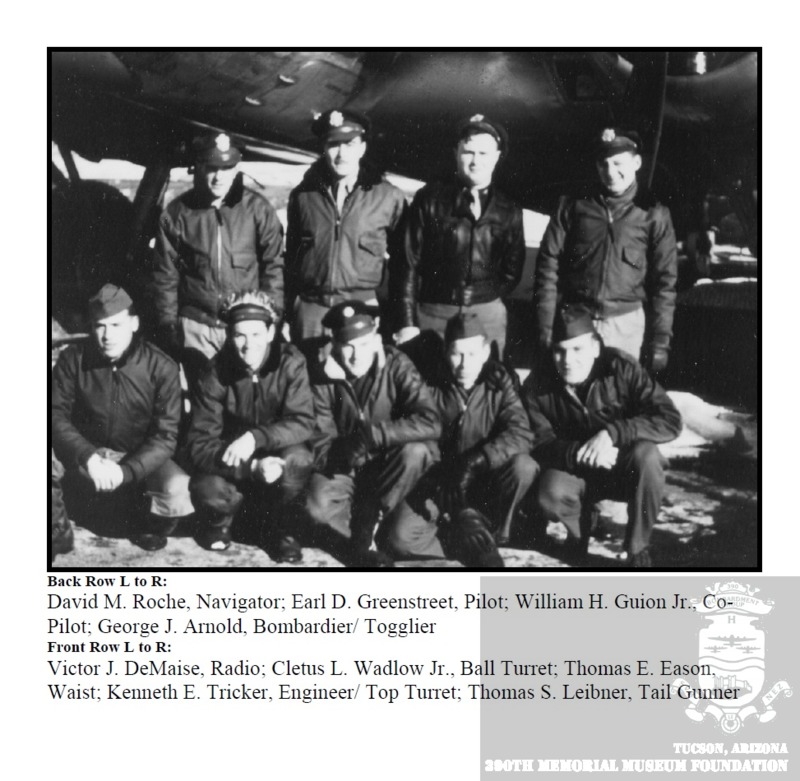
In January of 1945, the 569th squadron, with Eason on board, flew from France into Germany on a mission to bomb the city of Heilbronn, Germany.[10] There were nine men on the B-17 bomber, including Eason, on the day it flew into Heilbronn.[11] Each of the men were required to fill out an ‘Individual Casualty Questionnaire’ after their mission. From these questionnaires, the story of Thomas Eason’s last flight forms.
George J. Arnold, the bombardier on board, noted that enemy forces fired on the B-17 less than two minutes after entering the city, forcing the plane to leave formation “right before [it] hit the target—” the target being a bridge in east Heilbronn.[12] Earl D. Greenstreet, the pilot of the plane, wrote most explicitly, “We were shot up and just managed to get back across the lines on one engine. We were losing altitude fast, our remaining engine smoking and trying to burn. The terrain was hilly and I gave the bailout warning at about 1000 feet. That was lower than we had ever thought of bailing so I told them to pull the cord as soon as they cleared the ship. Eason was the next to the last out of the ship…” Greenstreet himself never bailed, instead piloting the plane until it crashed near the town of Steinburg, France.[13] According to a combat chronology listing by the Eighth Air Force Historical Society, on January 20, 1945, 223 B-17 bombers were sent to Heilbronn. Two of the B-17s were lost, and one was damaged beyond repair. The plane Eason was on, which crashed behind Allied territory, was no doubt included in these statistics.[14]
Every man who was in the bomber tells Eason’s story identically. The only differences pertain to where exactly he landed. But the general consensus seems to be that he landed in a field somewhere between the small towns of Altenheim and Metz, France. Both of these towns are very close to each other, and extremely close to the German border. Eason, being the second to last man to bail from the plane, jumped at less than 1000 feet. His parachute never deployed. The War Department listed him as killed in action (“KIA”).[15]
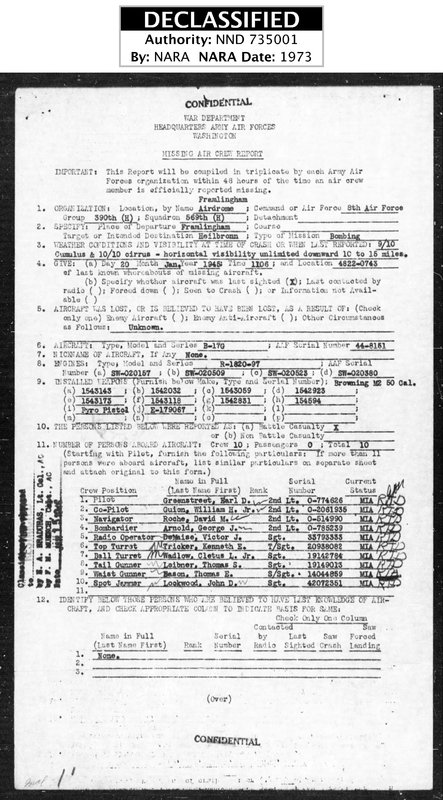
According to combat records, the entire crew of “Sweet and Lovely” were considered missing in action (“MIA”) until January 28, 1945. A ‘Missing Air Crew Report’ was written shortly after the failed bombing which listed all of the men on board, “MIA.” On January 28th, rescue parties found the flight crew, and by February 16th, they were all returned to duty (“RTD”)—with the exception of Thomas Eason. On the ‘Missing Air Crew Report’ mentioned above, someone wrote in pencil next to the “MIA” by each person’s name, “RTD—” a change in their conditions. Next to Eason’s name, the letters “KIA” stand by themselves near the bottom of the list.[16]
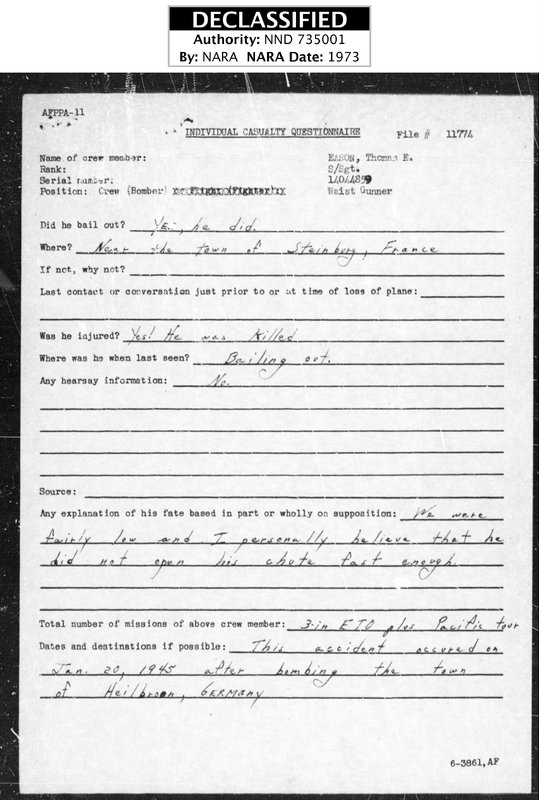
It is sobering, for me, to learn about Eason’s life and to understand the individual part he played in the enormity of World War II. Beneath the missions and the battle plans, real men like Eason, through their distinct sacrifices, cemented their time as inseparable from that of history and humanity. Thomas E. Eason served over three years in the United States Air Force—through the entirety of U.S. involvement during World War II. He enlisted as a private, eventually rising to the rank of staff sergeant by the time of his death. Surely, being in the army for so long, and aboard a B-17 with eight other men all the time, he had made close friends with those around him. In another ‘Individual Casualty Questionnaire,’ under the question, ‘Was he injured?’ the answer is handwritten— “Yes! He was killed.”[17] The writer responded vehemently, exclamation point and all, and it is easy to grasp the ridiculousness he saw in this question—or perhaps it was the ridiculousness of the situation that got to him—but either way, Eason’s death prompted an emotional response, and one that is tangible even through paper.
Written by John Lancaster
[1] "Thomas E. Eason," 390th Memorial Museum: Honoring Their Courage and Sacrifice, (2012), https://www.390th.org/interactive- library/?390th_tax_personnel=2816&tab=personnel (accessed October 10, 2016).
[2] Find A Grave, “SSgt Thomas E Eason (- 1945) - Find A Grave Photos,” (January 31, 2015), http://findagrave.com/cgi-bin/fg.cgi?page=pv&GRid=56372149 (accessed October 11, 2016).
[3] U.S. Census Bureau, "United States Census, 1930," FamilySearch, https://familysearch.org/ark:/61903/1:1:X3S2-WDP (accessed October 10, 2016).
[4] United States Enlistment Records, “Thomas E Eason – WWII Enlistment Record, Dade County, Florida,” Mooseroots, http://wwii-army.mooseroots.com/l/881355/Thomas-E-Eason (accessed October 10, 2016).
[5] United States, The National Archives, “Individual Casualty Questionnaire,” Missing Air Crew Reports of the United States Armed Forces, 1942-1947 (1945), https://www.fold3.com/image/46705960 (accessed October 10, 2016).
[6] "390th Bombardment Group - 8th AFHS," Eighth Air Force Historical Society, https://8thafhs.org/bomber/390bg.htm (accessed October 20, 2016).
[7] "Distinguished Unit Citations – OPHSA," (2006) http://www.ophsa.org/DUC/ (accessed October 20, 2016).
[8] "390th Bombardment Group - 8th AFHS," Eighth Air Force Historical Society, https://8thafhs.org/bomber/390bg.htm (accessed October 20, 2016).
[9] Ibid
[10] United States, The National Archives, “Individual Casualty Questionnaire,” Missing Air Crew Reports of the United States Armed Forces, 1942-1947 (1945), https://www.fold3.com/image/46705948 (accessed October 10, 2016).
[11] "Thomas E. Eason," 390th Memorial Museum: Honoring Their Courage and Sacrifice.
[12] George J. Arnold, United States, The National Archives, “Individual Casualty Questionnaire,” Missing Air Crew Reports of the United States Armed Forces, 1942-1947 (1945), https://www.fold3.com/image/46705953 (accessed October 10, 2016).
[13] Earl D. Greenstreet, United States, The National Archives, “Individual Casualty Questionnaire,” Missing Air Crew Reports of the United States Armed Forces, 1942-1947 (1945), https://www.fold3.com/image/46705959 (accessed October 10, 2016).
[14] "390th Bombardment Group - 8th AFHS," Eighth Air Force Historical Society, https://8thafhs.org/bomber/390bg.htm (accessed October 20, 2016).
[15] Earl D. Greenstreet, United States, The National Archives, “Individual Casualty Questionnaire,” Missing Air Crew Reports of the United States Armed Forces, 1942-1947 (1945), https://www.fold3.com/image/46705959 (accessed October 10, 2016).
[16] H.M. Rund, United States, The National Archives, “Missing Air Crew Report,” Missing Air Crew Reports of the United States Armed Forces, 1942-1947 (1945), https://www.fold3.com/image/46705942 (accessed October 10, 2016).
[17] United States, The National Archives, “Individual Casualty Questionnaire,” Missing Air Crew Reports of the United States Armed Forces, 1942-1947 (1945), https://www.fold3.com/image/46705948 (accessed October 10, 2016).