Corporal Wilson Foch Smith
Corporal Wilson Foch Smith, 654th Tank Destroyer Battalion
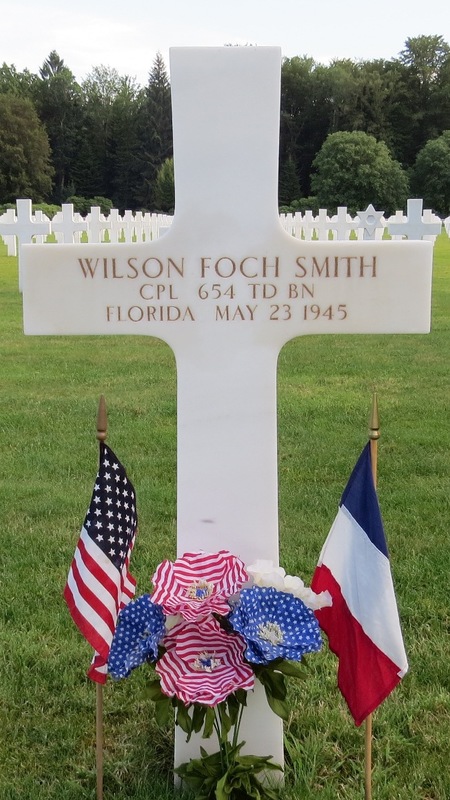
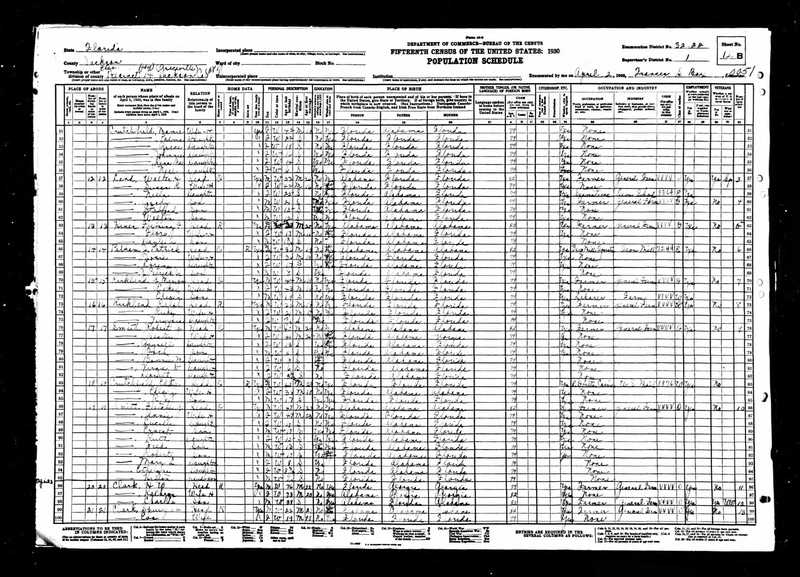

Corporal Wilson Foch Smith was born on October 24, 1918, in Graceville, Florida. He was the son of Robert and Hester Smith and had four sisters: Gaynell Smith, Bonnie M. Smith, Virgie D. Smith, and Dorothy Smith.[1] In his civilian life, Corporal Smith completed four years of high school and made his living as a farm hand after completing his education.[2] At the time of his enlistment, he reported that he had no dependents and that he was single.[3]
Corporal Smith enlisted in the U.S. Army on January 22, 1941. Corporal Smith served as a member of the 654th Tank Destroyer Battalion during the Second World War.[4] The 654th was activated on 15 December, 1941 at Fort Benning, Georgia. They arrived at Omaha Beach in Normandy on July 11, 1944 armed with M10's. The 654th Tank Destroyer Battalion is credited for playing a role in the following campaigns; Normandy 1944, Northern France 1944, Rhineland 1945, Ardennes-Alsace 1945, and Central Europe 1945.[5] Corporal Smith may have participated in all of the aforementioned campaigns.
The 654th moved through France and fought in Nancy in early September of 1944. By December they had crossed the German border into Saaragueraines. Just before Christmas they arrived in Luxenburg. On May 20th, they were in Lamsringes, Germany awaiting orders to return to the Unites States. Cororal Smith may have been sick or wounded because on the 23rd of May, 1945, Corporal Smith boarded a C-46 military transport aircraft which was transferring 41 ill or injured American soldiers to Paris. The soldiers were slated to be transported to the United States after arriving at Paris. For unknown circumstances, one of the two plane engines ignited into flames which caused the aircraft to crash near the town of Taillefontaine, approximately fifty-four miles to the northeast of Paris.[6] Corporal Wilson died as a result of the accident, along with 40 other soldiers and 4 crew members. He died only fifteen days after the end of the war in Europe.[7]
Written by Jay Aguilar and Lauren Geller
[1] 1930 United States Federal Census for Foch Smith, Florida, Jackson, Graceville, District 22, p. 2. Accessed 10 October 2016 www.ancestry.com.
[2] “World War Two Enlistment Records, Created, 6/1/2001-9/30/2002, Documenting Period ca. 1938-1946,” National Archives and Records Administration. Office of Records Services- Washington, D.C. Modern Records Programs. Accessed 11 October, 2016. https://aad.archives.gov/aad/record-detail.jsp?dt=893&mtch=11&cat=WR26&tf=F&sc=24994,24995,24996,24998,24997,24993,24981,24983&bc=,sl,fd&txt_24995=Wilson+Smith&op_24995=0&nfo_24995=V,24,1900&txt_24983=18&op_24983=0&nfo_24983=V,2,1900&rpp=10&pg=1&rid=878656&rlst=485697,4651749,5608814,526226,878656,1377433,1977188,3354325,3526110,5839582.
[3] Ibid.
[4] “Cpl Wilson Foch Smith.” Find a Grave. Accessed 10 October, 2016. http://findagrave.com/cgi-bin/fg.cgi?page=gr&GRid=56375616.
[5] “654th Tank Destroyer Battalion” Accessed 11 October, 2016. http://www.tankdestroyer.net/units/battalions600s/242-654th-tank-destroyer-battalion
[6] “Cpl Wilson Foch Smith.” Find A Grave. Accessed10 October, 2016. http://findagrave.com/cgi-bin/fg.cgi?page=gr&GRid=56375616.
[7] Ibid.