Introducing the 501F Advanced Gas Turbine
Work on the advanced 150MW-class 501F started before the move to Orlando. This new engine was being co-developed with Mitsubishi Heavy Industries (MHI), a decades-long Westinghouse licensee, acting in a new role as design partner, investing in the development, and working alongside Westinghouse engineers.
The design target was a 2300F (1260C) rotor inlet temperature, with a mature rating expected to be around 160MW. The introductory rating was set at 145MW with simple cycle heat rate of 10,000 Btu/kwh or 34 percent efficiency. The combined cycle efficiency being advertised at was "better than 50 percent."
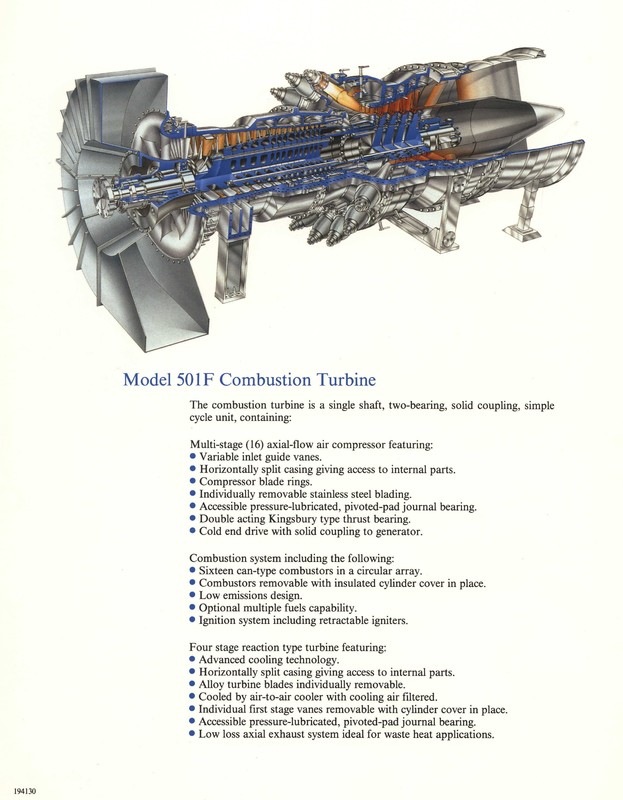
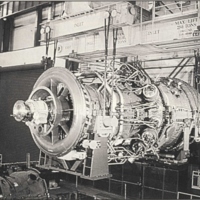
Although the 501F had many design changes and improvements to achieve higher firing temperature and better reliability, its family DNA is clearly rooted in the W501, as is evident from the image below included in the standard proposal listing its design features. Note the use 501F versus W501F, in deference to MHI, which to this day uses the Westinghouse model nomenclature for its large gas turbine products.
With the help of a team of Pittsburgh-Monroevill)-based marketing communications experts, Westinghouse continued its new advertising campaign for combustion turbines by producing new ads for the 501F. Unlike earlier CTSD ads, which were more technical and aimed largely at the engineering community, these ads were clearly aimed at getting the readers' attention.
To the left is a page from the new Value Plus brochure. Of special note in this promotional introductory material for the 501F was the promise of a "hybrid" dry-low-NOx combustion system based on a "proven" MHI design that had been in operation since 1984. Unfortunately, the holy-grail Dry Low NOx (DLN) system for the 501F actually proved to be somewhat elusive, and it wasn't until about five years later that it was actually offered commercially—used in the first Korea Electric order also shown below.
This writer has knowledge of one negotiation for a 501F to be applied in a cogeneration combined cycle project to be built in Florida around 1992. The initial Westinghouse thermal cycle work and proposal were based on use of the DLN combustion system that was being advertised. Success in the negotiation was dependent on whether Westinghouse and MHI would support that offer, but it was decided to retract it, and replace it instead with steam injection for NOx control. GE received the order and, it is understood, developed the first Frame 7F DLN burner on that project.
It is noted that the first four 501F gas turbines were sold to Florida Power & Light Company for the repowering project in Fort Lauderdale, and went into service in 1993 using steam injection for NOx control. The first W501F units to actually include DLN combustors were the first built by Westinghouse to fill the Korea Electric Company order in 1995. The first unit made internal headlines in the PGBU newsletter.
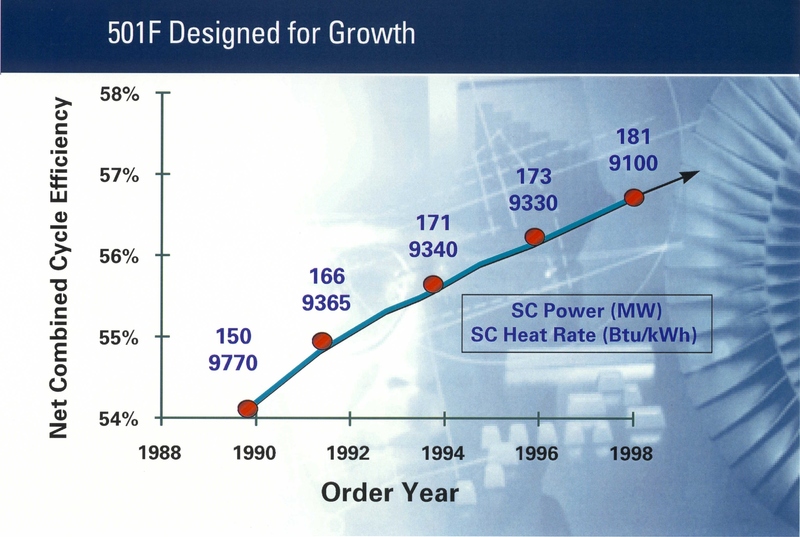
As noted earlier, the introductory rating of the 501F in 1988 was 145MW, when it was said that the mature rating would exceed 150MW. This chart shows the growth of the F machine between 1988 and 1998. The curve plots F-class combined cycle efficiency versys time, with simple cycle power rating and heat rate shown at intervals along the development timeline. As of this writing in 2015, MHI offers the M501F3 at 185MW and Siemens offers the SGT6-5000F (aka 501F) at 242MW, approximately the rating of the original 501G below.