Technology Evolves Rapidly as Market Grows
In spite of the fact that it might appear to have been a sellers’ market for peaking units during the late 1960 sand early 1970s, there was still fierce competition for market share. Besides having adequate shop space to serve the market, the major manufactures, such as GE and Westinghouse, were in a race to find ways to lower the price ($/kW) of their offering to get the competitive advantage.
This was also the time when the jet engine manufacturers, GE, Pratt & Whitney, and a number of third-party "packagers," entered the market with their packaged units. These proved to be very quick to install and highly efficient, and gained a lot of attention. Efficiency was not as important as price since only intermittent use was planned for them.
The key to lowering $/kW was to increase engine power rating. This was achieved in two ways: First, be able to offer a larger unit than the competition, and with the W501 Westinghouse did just that and was able to make up for its relatively low volume in comparison to GE. Once the basic frame size is set, incremental rating growth can be achieved by increasing turbine firing temperature, such as "turning up the wick."
Following the introduction of the W501A in 1967-1968, Westinghouse technology quickly continued to evolve as turbine inlet temperatures increased by means of improved internal cooling and advanced metallurgy, and pressure ratios increased with improved compressor designs.
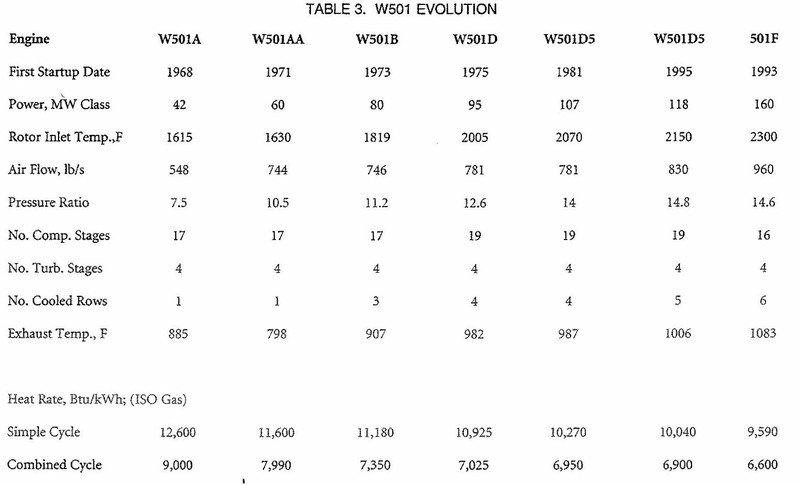
Over the period from 1968 to 1975, the W501 progressed from the W501A (~40MW), W501AA (~60MW), W501B (~80MW) and the W501D (~95MW). The next major redesign was the W501D5, introduced in 1981, initially at a rating of 96.5MW, growing to 107MW gross around 1985. In 1995, the W501D5A upgrade was offered at about 120MW.
The following chart extends to the mid-1990s, showing the then-current latest offering, the W501F, rated at 160MW with a first start-up date of 1993. Four units were installed at the Florida Power and Light station repowering project in Fort Lauderdale, Florida.
A similar chart for the smaller geared model W251 shows how that model actually led the way to some of the technology steps taken in the evolution of the W501.
Note: At the same that the American Society of Mechanical Engineers (ASME) Gas Turbine Conference, where the above-referenced ASME paper by A.J. Scalzo, et.al. was presented, Westinghouse also delivered a paper announcing plans to develop a 250MW-class gas turbine, the 501G. To be designed by the Westinghouse-MHI-FiatAvio alliance, the design featured a steam-cooled transition duct, another of many industry firsts for Westinghouse (see Appendix I). The first 501G was installed at McIntosh station in Lakeland, Florida, and was first synchronized to the grid in April of 1999.