Introducing the 250MW-Class W501G
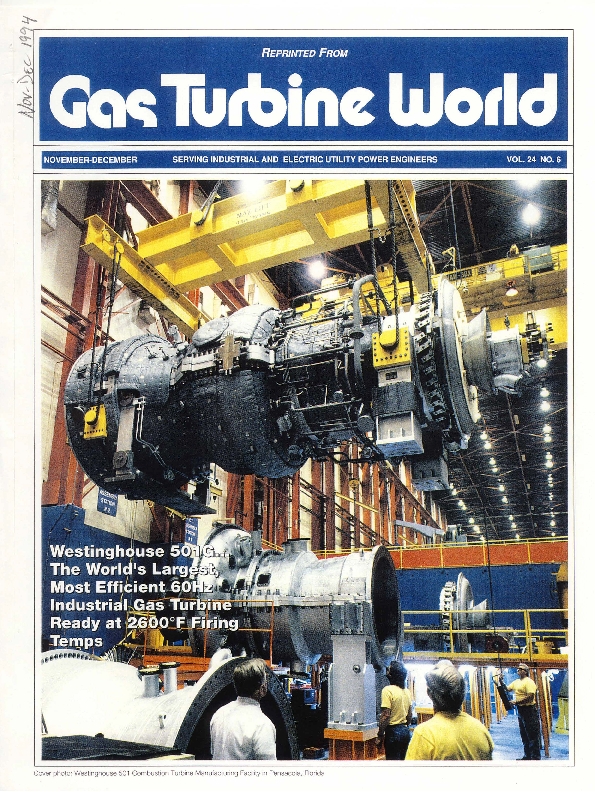
Around mid-1994, two announcements were made almost simultaneously—one at the American Society of Mechanical Engineers (ASME)'s International Gas Turbine Conference at The Hague in June, and the other at the Edison Electric Institute's meeting in Seattle, Washington. Westinghouse and its then-trilateral alliance partners, MHI and FiatAvio announced their new W501G (501G) high-temperature gas turbine that would operate at 2600F turbine rotor inlet temperature. This announcement was ahead of any such similar announcements by GE or Siemens, both of which were also rumored to be working on their own high-temperature machines.
The W501G was advertised as the largest and most efficient 60Hz gas turbine in the world, boasting of an introductory power rating of 230MW and a simple cycle efficiency of 38.5 percent (8860 Btu/kWh, Lower Heating Value) and with a combined cycle efficiency of 58 percent (5880 Btu/kWh, LHV).
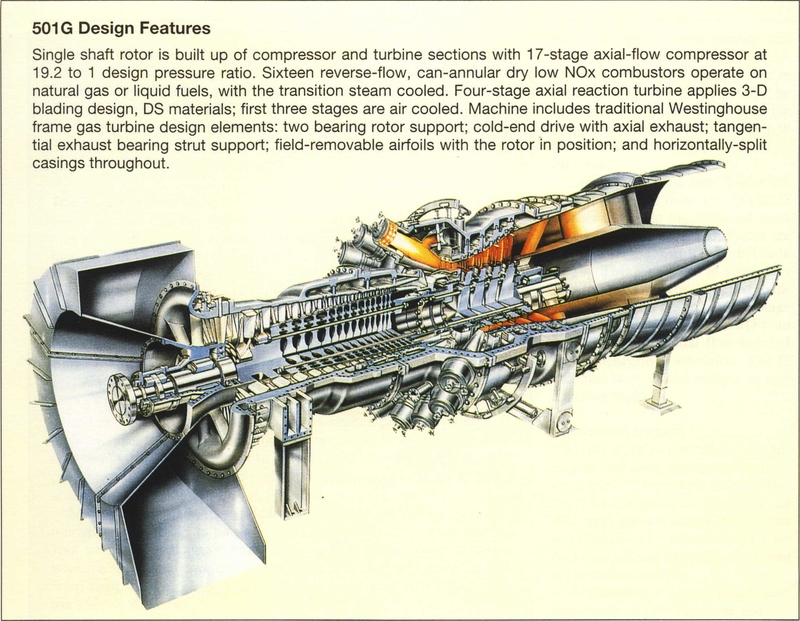
The W501G was touted to be a new machine, with an advanced 17-stage compressor design achieving a 19:1 pressure ratio—versus a 15:1 ratio for the W501F. The combustion section featured DLN combustors with <25ppm NOx on gas—as advertised from the start—and, notably, steam-cooled transition ducts. This novel design substantially reduced the amount of cooling air needed in the hot section of the engine, and eliminated the dilution effect of transition cooling air in the combustion zone.
The design of the W501G turbine section, while continuing to use the basic traditional 4-stage through-bolted-disc rotor configuration of Westinghouse W501D design, but had technology input from Rolls-Royce's aero engineering department, employing 3-D blading design code for all stationary and rotating rows. It also features advanced material and coatings, as well as improved air-foil cooling designs to withstand the increased hot-gas-path temperatures—250F higher than the W501F at the rotor inlet at the time.
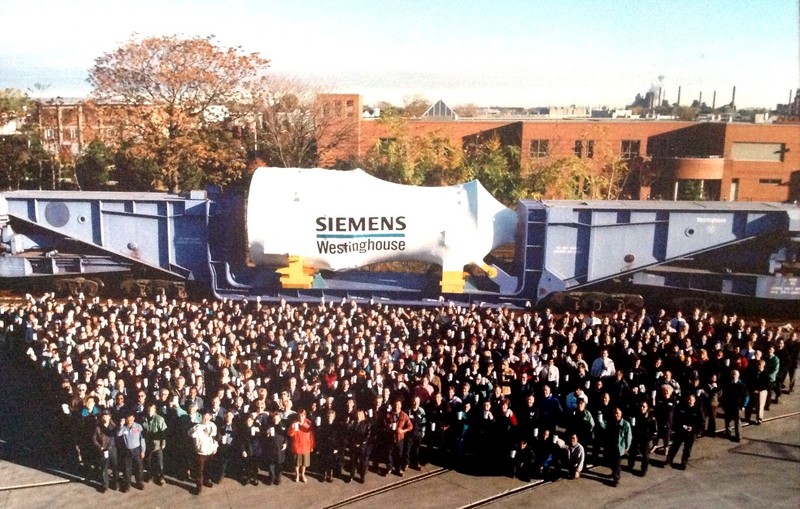
The prototype W501G was installed at the McIntosh station in Lakeland, Florida, and was first synchronized to the grid in April of 1999, shortly after the Siemens acquisition of Westinghouse PGBU. Hats off to the CT Engineering team that worked to bring it all about, including Leroy McLaurin, who headed up the 501G design team, and ProgramMananger Pete DeRosa, who headed up the engineering project for the prototype engine manufacturing and installation. Other project participants of special note were Engineering Manager Les Southall and Project Manager Roger Greenfield.
It is noted that current Siemens gas turbine product offerings do not include the G model, as it was replaced, first by the advanced air-cooled F model and then by the 300MW H model. MHI continues to offer the G model—both steam-cooled and air-cooled, rated at around 270MW, as well as their new 300MW-plus model M501J.