The Great Northeast Blackout of 1965
It is well known that there was an increase in the birthrate in the northeastern U.S. and parts of Canada during the summer of 1966. This was just one of the results of the Great Northeast Blackout which took place on November 9, 1965, nine months before the mini-baby boom.
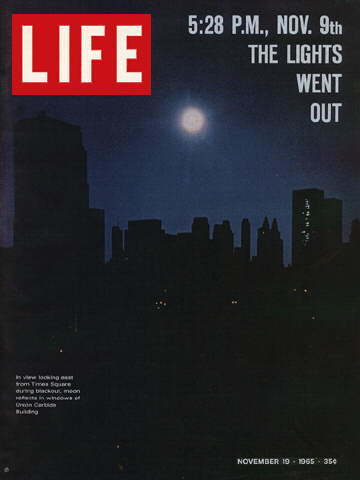
Another, somewhat more esoteric result, was the birth of the modern gas turbine industry in the U.S. Although the actual culprit behind the massive power outage was found to be a single faulty relay at a transmission station in Ontario, Canada, the "cascade" or domino effect on downstream trunk lines caused the entire Canada-United States Eastern Interconnection (CANUSE) system from Canada, through Buffalo, New York, and to the east coast from New York City to Maine to go down in a quarter of an hour.
In spite of the relatively simple nature of the original failure, an important ramifications of this historic event was recognition of the need to strengthen the grid and improve system restart capabilities. Electric utilities throughout the U.S. were mandated by their regional "Reliability Councils," such as the North American Electric Reliability Corporation (NERC) for the northeast, to increase their system reserve margins by installing a certain percentage of their overall capacity in the form of smaller localized fast-start generating units, much of them with "black start" capability to assure that large plants and grids could be restarted in the event of another major outage.
And it didn’t hurt that the summers of 1966 and 1968 saw major summer heat waves and record peak demands.
The result was a wave of gas turbine generator installations, chosen as the fastest and most economical way to meet this mandate—ergo, the Westinghouse "The Economic Choice” marketing campaign at the time. Annual utility purchases of additional units became a routine event as long as the peak load demand continued to increase.
Large orders of multiple units were often taken over the phone, as repeat customers raced to obtain their annual allotment. Tracking the regional and national peak demand curves became the main tool to planners who had to forecast the market and set the shop "load plan." This writer wonders whether the gas turbine suppliers of that time developed "reservation agreements" as was the practice adopted during another boom period, 30 years later.
Accordingly, most gas turbines installed in the U.S. during the late 1960s and early 1970s were applied as simple cycle peaking units, or "peakers," intended for system backup and intermittent use, and installed to maintain adequate reserve margin.
Importantly, the early 1970s also witnessed the success of the early combined cycle plants and, as the peaking market started to level off, and, for the time being, this helped sustain the U.S. utility market for large gas turbines.
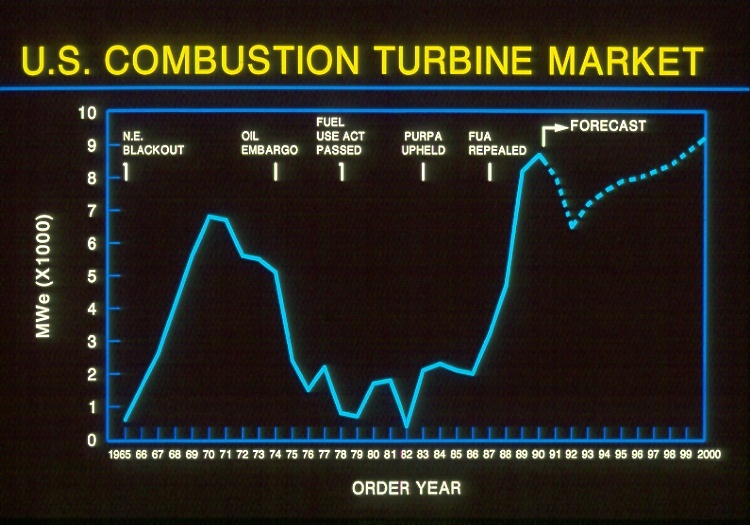
One report has it that the demand for gas turbines in the U.S. hit almost 9GW in 1969, a 30-fold increase over the total of 300MW sold in 1961. The chart to the right shows that market peaked at around 7GW.
No wonder that forecasts for future market growth were so optimistic. At the start of 1970, Turbine Topics, the internal newsletter of the Small Steam & Gas Turbine Division, which was the predecessor of the Gas Turbine Division, contained this statement from the Marketing Department: "The sum total of all this tells U.S. that the fantastic growth of the 60s will perpetuate into the 70s."
However, the market had already shown signs of weakening by 1971-1972, and, unfortunately, subsequent global events had a lot to say about whether that rosy forecast would come true.