Changes in Westinghouse's Relationship with Mitsubishi Heavy Industries
Note: This section is based primarily on personal recollections of one of the key engineers involved in the episode.
A significant development that took place near the close of the Concordville years involved a major change in the relationship between Westinghouse's Combustion Turbine Systems Division (CTSD) and its long-time licensee, Mitsubishi Heavy Industries (MHI). Many credit this development as a key event in Westinghouse's long -term survival as a major participant in the gas turbine industry, and the key to the Siemens acquisition of the business 10 years later.
By the mid-1980s, it had already been decided that gas turbine manufacturing operations at the plant in Lester, Pennyslvania, would cease by the end of 1986, and, also, that manufacturing of the popular W501D5 engines would be outsourced from the MHI plant in Takasago, Japan. This plan enabled CTSD to put into place at least a temporary means of continuing doing business—to obtain and fulfill orders for large gas turbines as the American cogeneration and IPP markets were developing. As noted earlier, the first MHI-built engines were installed at the Texas City Cogeneration plant. According to internal records, the total number of W501D5s purchased by Westinghouse from MHI was 10, as were the first four 501F engines.
The next development in the Westinghouse-MHI relationship came in 1986 when MHI shared a study that indicated that the global market for its 50-Hz scaled version the Westinghouse gas turbines—called the MW701D—would soon see a strong return, and they proposed the joint development of a new advanced 50 Hz engine to be called the 701F. General Electric was already developing its Frame 7F at the time. The 60-Hz design for the markets served by Westinghouse would follow.
Since Westinghouse corporate support of advanced gas turbine development and design at that time was nil, Westinghouse agreed to supply key engine design engineering support, as specified by MHI, and MHI provided the funding to support the effort, as well as to manufacture the prototype engine. Joint conceptual design started in mid-1986 and, somewhere early in the effort, it was decided that the first engine should be the 60-Hz 501F version of the design. MHI would subsequently complete the scaling process for the 50-Hz design. The new design provided both companies with the opportunity to incorporate some important design improvements and attributes that were not feasible to be back-engineered into existing W501D5/MW701D designs, but could readily be introduced into a new design.
Despite the reduction in work force at Westinghouse and the interruption caused by preparation for the move of the Combustion Turbine Operations to Orlando—announced in October of 1986—work progressed steadily on the new engine design. Westinghouse had agreed to take on about 60 percent of the design effort on the new engine, and the work effort continued with the actual move of the engine engineering staff in April of 1987 to Orlando. Although many employees decided, for one reason or another, including many taking early retirement, to not make the move south, the joint development program with MHI greatly benefited from the decision of several of key engineers who agreed to delay their retirement, temporarily, move to Florida, and continue to work on the program.
The joint design effort continued through June of 1988 with major design reviews being held quarterly. Meeting sites for these reviews alternated between Orlando and Takasago, Japan. From start to finish, the total design effort spanned just 23 months and was completed on schedule. Based on the circumstances—such as the move from Concordville, loss of key employees, cultural differences, language barriers, and the distant site logistics—the project was considered to be an excellent example of engineering and management teamwork and a significant accomplishment for both Westinghouse and MHI.
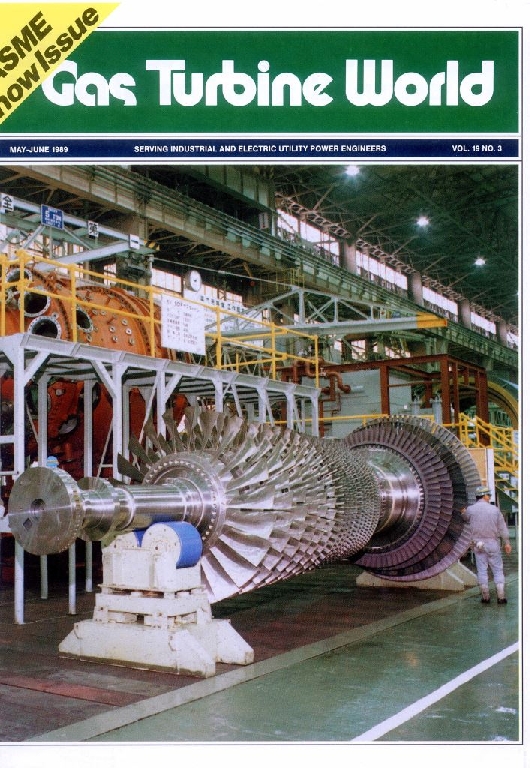
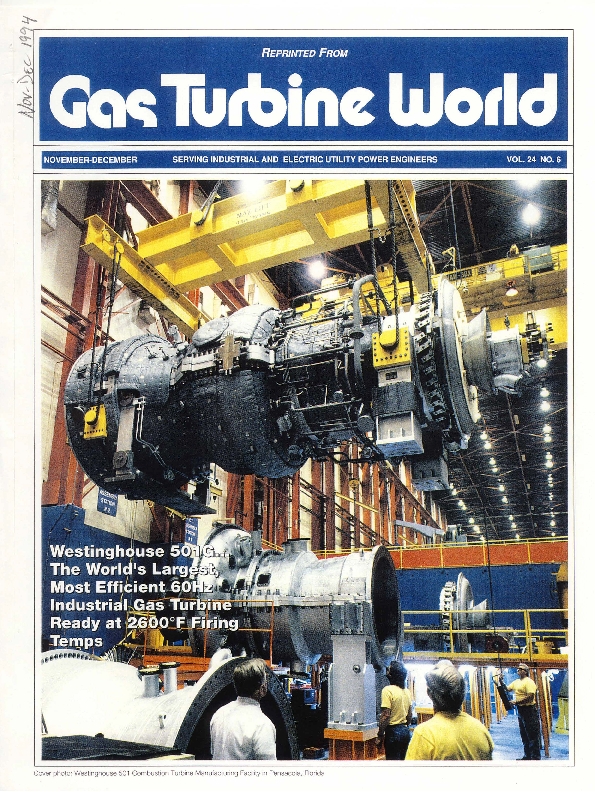
The 501F program permanently changed the relationship between the two companies, giving each independent and royalty-free manufacturing and marketing rights to the new engine.
The prototype 501F engine was built and shop-tested at MHI's turbine factory and development center at Takasago in mid-1989. In 1990, Westinghouse secured an order for the first four 501F units, built in Takasago, from Florida Power and Light Company (FP&L) for their Lauderdale Station Repowering project, which started operation in mid-1993. The contracted ISO rating of those units was 158MW.
Essentially coincident with the start-up of the FP&L Lauderdale plant, Westinghouse announced to MHI that they would start development and production of an up-rated 501F, the 167MW FB, which resulted in another joint effort between Westinghouse and MHI. Again, both parties put teams in place and the up-rated design was accomplished as scheduled. The first Westinghouse-built 501F was shipped from the plant in Pensacola, Florida, in October of 1995 for the Korea Electric Power Company (KEPCO) project in Ulsan, Korea.
At about the same time, Westinghouse and MHI were well on their way toward the joint development of the steam-cooled 250MW-class 501G engine.