Round Rock: A Case of Some Very Bad Timing
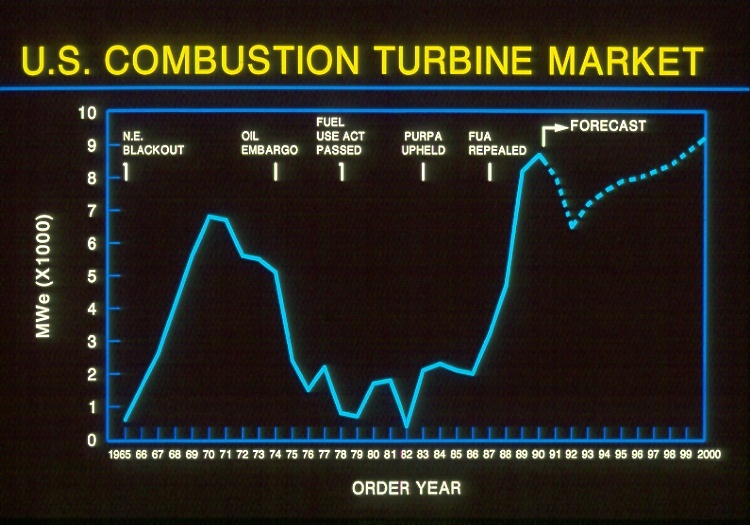
Based on the surge of gas turbine business in the late 1960s, Westinghouse, following the example of market leader and arch rival General Electric, decided to build a modern new gas turbine manufacturing plant at Round Rock, Texas. However, by the time that the plant went into operation around 1972, the U.S. market for gas turbines was about to collapse due to the impact of the Yom Kippur War in 1973 and subsequent fears of fuel supply instability due to the Organization of Arab Petroleum Exporting Countries (OAPEC) oil embargo in 1974. Also, unlike GE’s plant in Greeneville, South Carolina, the new Round Rock factory was not built as a stand-alone plant with full manufacturing capabilities, as already existed in Lester. Major components were shipped from Lester and other suppliers for final assembly at Round Rock.
As the market collapsed (see chart below), it didn’t take very long for Westinghouse management to act reduce the surplus of shop space allocated to gas turbines. Since Round Rock could not survive on its own, it was ultimately abandoned as a gas turbine manufacturing facility in 1976. Other large rotating equipment operations moved in, such as those of the East Pittsburgh direct-current (DC) motor products and Buffalo Large Motors Division. Ultimately, the large motors operations of Westinghouse were sold to Taiwan Electric Company (TECO) and the plant is now owned by TECO-Westinghouse, and is used to serve its wind generator business.