Early Land-Based Gas Turbine Experience
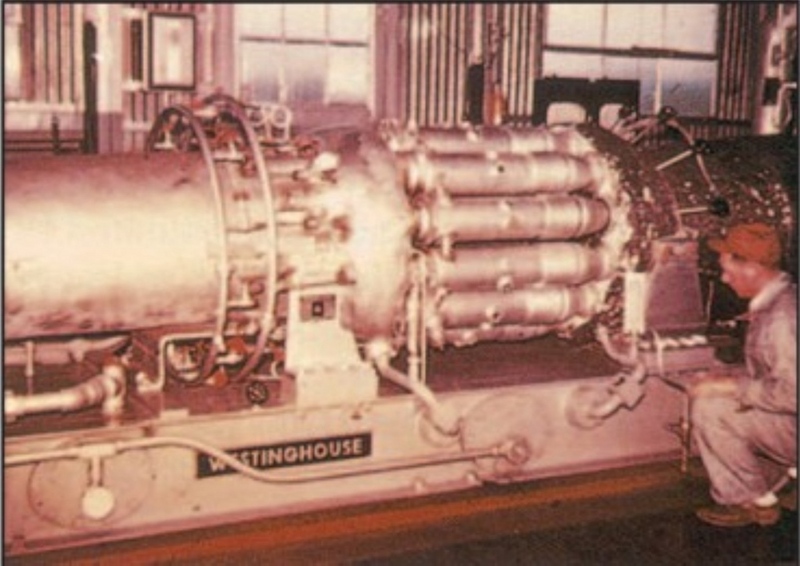
Westinghouse experience with land-based gas turbines started as early as 1945 with the development of a 2000 hp (~1500kW) gas turbine generator set, the W21. It had a thermal efficiency of 18 percent Lower Heating Value (LHV). The first application of the W21 in an industrial setting was as a gas-compressor drive installed at the Mississippi River Fuel Corporation facility located at Wilmar, Arkansas.
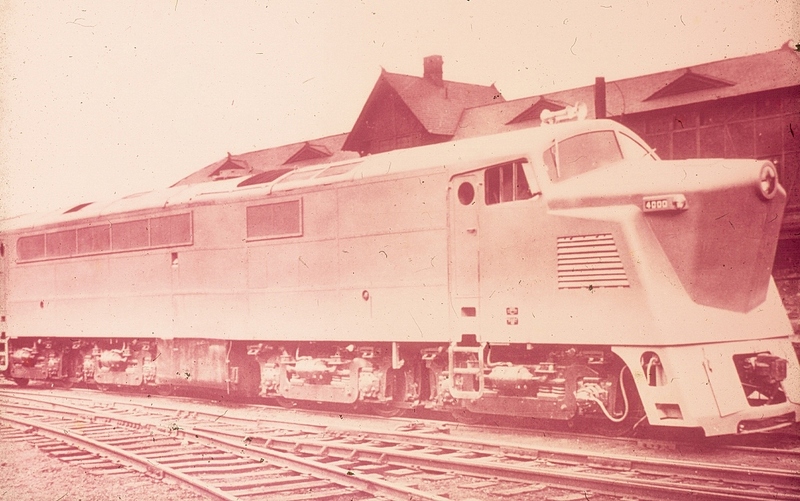
By 1948, Westinghouse also built an experimental 4000 hp gas turbine-driven locomotive with the Baldwin Company of Chester, Pennsylvania, that used two of these units. Initial operation was on the Union Railroad burning distillate fuel oil. Later, operation was on the Pittsburgh and Lake Erie Railroad using residual oil fuel.
The vast majority of the early applications of Westinghouse land-based gas turbines were for industrial mechanical drives in the petrochemical industry, both in the U.S. and abroad. Large multiple orders were placed by pipeline companies looking for compressor drives to be placed at remote locations. But by the mid-1950s, gas turbine power plants were becoming recognized as a practical alternative to steam turbine generators for certain applications, first for industry and later for electric utilities.
For industrial “total energy” applications, the important factor was that gas turbines, combined with heat recovery boilers, offered a higher power-to-steam ratio than the traditional back-pressure steam turbines used to supply both power and process steam. Thus, gas turbines were put to use for combined heat and power by the petrochemical industry, working hand-in-hand with companies such as Westinghouse, well before the word “cogeneration” entered the modern lingo some 30 years later.
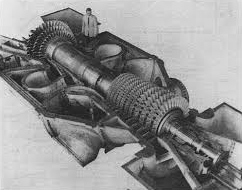
Note is added here to acknowledge the pioneering work by Westinghouse in the unique application of a W201 installed at U.S. Steel Works in Chicago in 1960. The engine was used to drive a 12,500-scfm fan to blow air into a blast furnace, and the design requirement was to use blast furnace exhaust gas as its fuel. The engine was modified so that all compressor discharge could be removed and fed to an external burner, from which products of combustion were returned to drive the turbine. Typically, blast furnace gas has a heating value of less than 100 Btu/scf, one-tenth of that of natural gas.