A Pioneer in U.S. Jet Engine Development
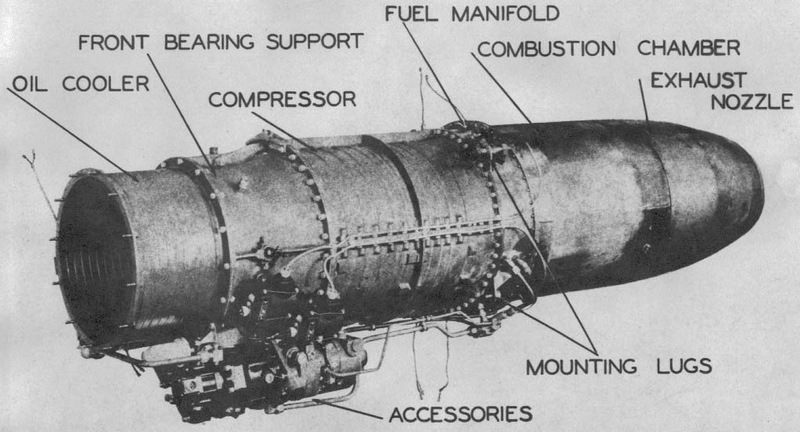
In March of 1943, the first U.S.-designed and -manufactured jet engine went on test at Westinghouse, 15 months after the signing of a contract with the U.S. Navy. This first engine, with a 19-inch intake diameter, was designated the WE19A and had a thrust of 1130 pounds and weighed 827 pounds.
Due to wartime secrecy, Westinghouse worked on its own, with no prior jet engine experience and without knowledge of German, British or other US jet engine developments. The result was the first US jet engine design, complete with an axial compressor, an internal annular combustor, a turbine and jet exhaust nozzle.
The basic principle of the engine was similar to the original Whittle engine developed in England, but Westinghouse’s use of an axial flow compressor, along with internal combustion chamber, were major advancements that led the way to a practical engine for aviation propulsion. Earliest General Electric jet engines, based on the Whittle design and developed with Allison, featured a centrifugal compressor. GE and Allison had the Army contract to develop a “land-based” jet while the Westinghouse Navy contract was for carrier-based Navy jet fighters
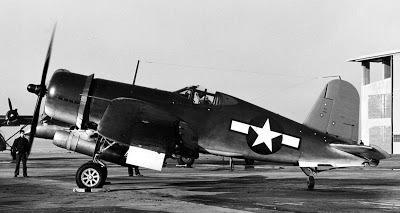
An improved version of the first engine, the WE19B, was flight tested in January 1944 as a booster unit on a Chance Vought Corsair FG-1 fighter (photo). It delivered 1365 pounds thrust and weighed 731 pounds.
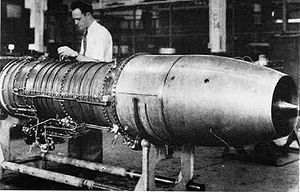
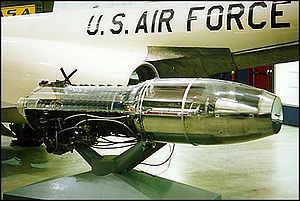
One year later, as the J30 engine, it was used to power the Navy’s first jet fighter, the McDonnell Douglas FH-1 Phantom. Sixty-one Phantom planes were equipped with the J30 engine. It is noteworthy that Pratt & Whitney Aircraft—then a major producer of piston aircraft engines for the military—was brought into the jet engine business in 1945 as a licensee to build the J30 engine.
In the late 1940s, to meet the growing needs of the Navy for higher thrust and longer range (a jet bomber was planned, as well as new Navy fighter jets), Westinghouse began development of the J40, with a target thrust of 7500 pounds (10,900 pounds with afterburner).
Unfortunately, in spite of so much earlier success, the J40 program became bogged down by delays and development problems. Some of the problems were apparently due to the overweight airframe, the McDonnell F3H-1N Demon. Both the J40 and the Demon were grounded after a number of aircraft were lost, and later, the upgraded F3H-2N used Allison engines. Ultimately, other aircraft planned for the J40 were either cancelled or outfitted with alternative engines, and the J40 was never qualified for full production. The program was terminated in 1955.
Although production and support of the J34 continued, Westinghouse exited the jet engine business in 1960, closing the Kansas City operation, after having supplied engines for 1223 Navy jet planes. Ironically, the first Pan Am Boeing 707 had just flown its maiden commercial flight, powered by Pratt & Whitney engines, just a year before.
Thankfully, Westinghouse had other ideas for applying its jet engine technology and experience: land- based prime movers – first as industrial mechanical drives and then to power electric generators.