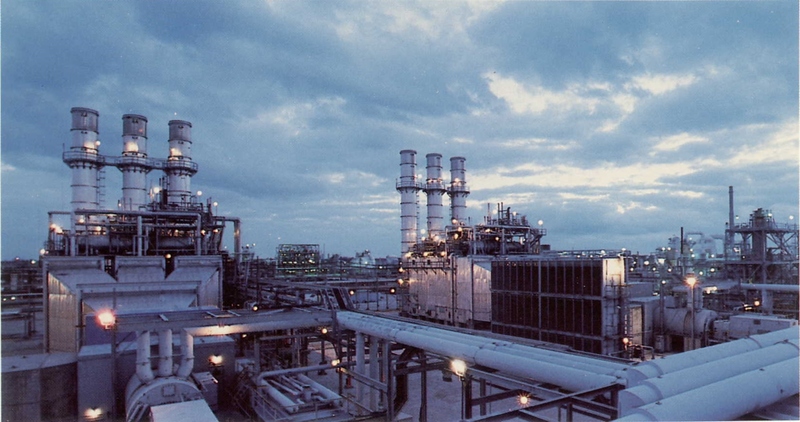
Dow-Destec IGCC at Plaquemine, Louisiana
As might be imagined, the idea of burning coal, or some derivative of it—be it liquid or gas—in a gas turbine gained considerable attention and government support during the late 1970s and into the 1980s. "Synthetic" gas or liquid fuels made from coal were considered "alternative fuels," encouraged under the Fuel Use Act (FUA), and the development of various such fuels was being heavily supported by the U.S. Department of Energy (DOE).
In fact, Westinghouse was already working under government contract to develop its own coal gasification process. A process development unit was built at Waltz Mill, Pennsylvania, and operated by the Research and Development Center. To show its commitment to commercialization of the technology, Westinghouse even formed the Synthetic Fuels Division (SFD) around 1983, headed by Bill Pease, one time steam turbine marketing manager. (SFD was later disbanded around 1987, as the DOE contract expired, and the rights to the process were sold to Kellogg-Rust. See Appendix IV for more information.
In the meantime, the Dow Chemical Company was looking into how it might utilize large lignite holdings in Texas to reduce its dependence on natural gas to fuel its vast on-site power generating facilities. Not that its on-site power operations were necessarily impacted by the Fuel Use Act, but it seemed like a good hedge just in case the natural gas shortage turned out to be the real thing.
The Dow plan was to obtain government assistance to demonstrate a new proprietary coal gasification process and use the product gas to fuel the new gas turbines at the Louisiana Division facility in Plaquemine, Louisiana.
Dow undertook development of its process—later to be called E-Gas—and pursued government support from the Synthetic Fuels Corporation, established in 1980 for the purpose of nurturing a synthetic fuel, such as coal-derived gas or liquid, industry in the United States as part of Project Independence.
In the meantime, Dow and Westinghouse engineers worked toward converting the two new W501D5 gas turbines that were installed at Plaquemine from 1982 to 1983. As a first step, in 1981, they took on the conversion of an old W191 to burn medium-Btu gas—approx. 300 Btu/scf vs. 1000 Btu/scf for natural gas. See Appendix IV for more information.
The 15MW demonstration was successful and the full-scale program went ahead. Dow proceeded to build a full-scale gasifier sized to supply the two W501D5s, and Westinghouse was given the go-ahead to design and manufacture the new fuel nozzles. Since the gas turbines were an integral part of plant operations, the specification was to assure dual-fuel capability, so that the unit could easily revert to natural gas when the gasifier was not in operation.
Fortunately, Westinghouse combustion engineers had earlier worked under subcontract on the DOE coal gasification contract to demonstrate low-Btu gas combustion on W501B components. Later, that work led to the design of W501D5 combustors to incorporate features, such as a larger-diameter head end, to make them adaptable to use of low-Btu gas fuel. So the Plaquemine units were essentially "syngas ready" and were readily modified. Could it be that Westinghouse low-Btu fuel experience actually influenced Dow’s buying decision for those units? We liked to think so.
The conversion of the two 100MW+ gas turbines at Plaquemine to burn gasified coal created the largest integrated-gasification combined cycle (IGCC) in the world, and was very successful for Dow. The Synfuels Corporation contract continued to subsidize the production of synthetic fuel gas from coal for about 20 years before the subsidy expired.
Later Dow—or actually Destec Energy—was able to participate in the DOE-supported repowering of the Public Service Company of Indiana power station in Wabash, Indiana, with an advanced F-class gas turbine burning gas produced by an E-Gas gasifier. Unfortunately, Westinghouse did not get the order from Public Service Co. and the project used a GE Frame 7F. Today, the Wabash gasification system is operating on a commercial basis, selling coal-derived gas to the 250MW Wabash combined cycle power plant.
Needless to say, Dow never implemented conversion of their own power generating facilities at any of their Gulf Coast locations. Natural gas remained plentiful, and, in recent years, has become a cheaper fuel than it was 30 years ago.
It also noteworthy that Dow no longer installed its own on-site generation. Various IPP developers located generating plants near to their facilities to supply power and steam. These off-site cogeneration facilities enabled Dow to retire much of their older generating capacity. Unfortunately, unlike days of old, Westinghouse did not manage to get its share of this IPP business associated with Dow's operations.